
Short answer
Compare three ways to meet the same household needs: buy a suitable existing home, adapt a property or build a new one. Use a complete project budget and the same priorities for every option. The right route depends on the specific property, work required and decisions you are prepared to manage.
Compare three routes to the same home
Start with your non-negotiables: location, bedrooms, everyday circulation, outdoor space and a comfortable overall investment. Buying may suit you if a property already meets those needs with limited work. Remodeling may suit a home whose location and useful structure you want to keep. Building may suit a site where the home you need cannot be achieved through a sensible alteration.
For each property, record what must be investigated rather than assuming the listing, existing appearance or catalogue plan answers it. Compare a real candidate purchase with a defined remodel or build scope. Neither new construction nor renovation is automatically the cheaper or quicker route.
Compare the complete undertaking
Use three columns: buy, remodel and build. Include the property purchase where applicable, investigation, design and engineering, approvals, construction, site and utility work, finish selections, and any temporary accommodation. Keep financing, ownership and transaction costs visible for review with the appropriate advisers.
Separate confirmed amounts from allowances and unresolved items. Give each major unknown a next action: inspect a structure, obtain records, test a site layout or request a scope-based proposal. This produces a practical decision before you commission a full design.
- Which option meets the most important household needs?
- What usable space and outdoor area remain after the proposed work?
- Which unknown could change the decision, and who will investigate it?
Find what can stay
Have the appropriate design and engineering professionals assess what can safely be retained. An old plan or an exterior photograph cannot establish structural condition.
Compare like with like
Use one sheet with two columns. Record what each option assumes instead of treating an unknown as a saving.
- Existing structure and utilities to retain or replace
- What changes in floor area, daylight and access
- Temporary housing, investigation and site work allowances
Decide what needs investigation
If the outcome depends on one wall, one foundation or one approval, ask what investigation would resolve it before paying for two complete designs.
Put it into practice.
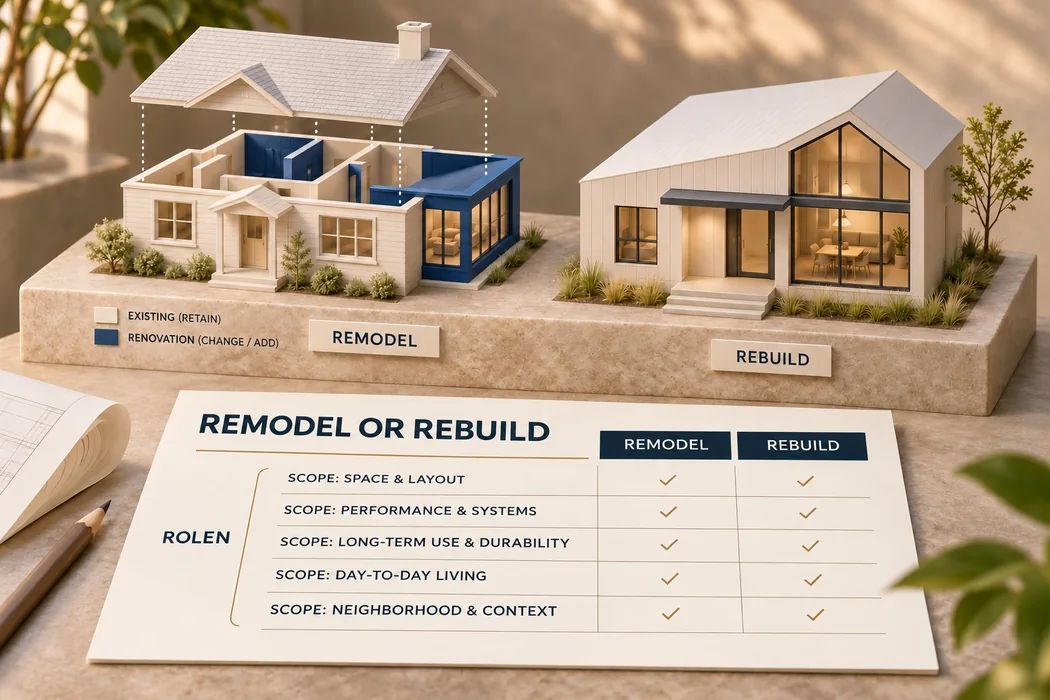
Compare remodeling and rebuilding
Put the same family priorities next to both options. Ask what can be retained, what needs professional assessment and what each approach would change about daily life.